Datatables Stop Current Post and Start Again on Request
Discover: this article is updated in October 2019, for latest version of QuickAdminPanel generated lawmaking.
Our QuickAdminPanel relies on Datatables.net library to show the data. It has quite a lot of settings, options and configurations, and so in this article I will prove how to use them later downloading your panel.
What is covered in this article:
- Edit/Remove Buttons like Copy/CSV/Excel/PDF/Print/Column Visibility
- Add/Customize Table Columns: Show ID and Timestamps
- Customize Consign Columns for PDF/CSV/Excel
- Customize Pagination Options
- Modify Your Language or Translate Some Text Phrases
- Modify Ordering past Columns
Disclaimer: nosotros will use a panel with our AJAX Datatables module, that uses server-side rendering. If you're non familiar with it, read about this module and/or spotter this video.
Our starting point is a downloaded fresh admin panel with Users list.
For non-QuickAdminPanel users: if you merely desire to know Datatables tips from this article, then you lot tin can download the starting project adminpanel here, install information technology locally and follow along.
Ok, permit's begin.
For a better sit-in, I've added 50 users with "Simple user" role, in database/seeder/UserSeed.php:
factory(App\User::class, l)->create()->each(function ($u) { $u->role()->attach([2]); }); Here's how it looks:
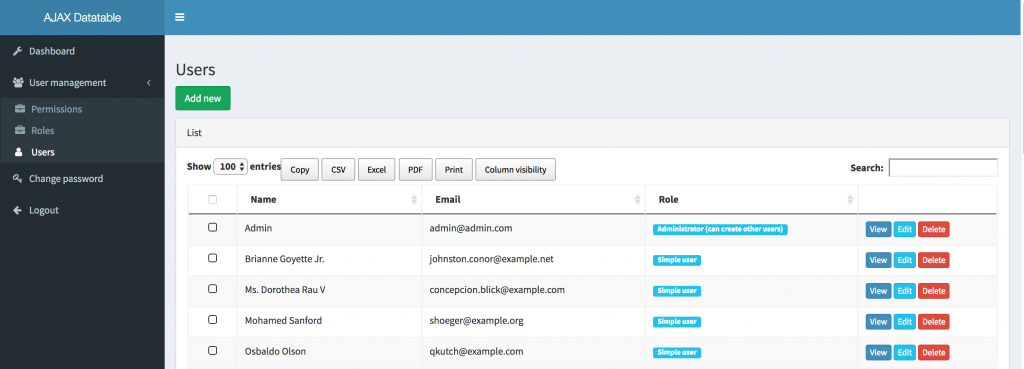
Now, permit'southward change some settings to have unlike view.
1. How to Edit/Remove Buttons similar Copy/CSV/Excel/PDF/Print/Column Visibility
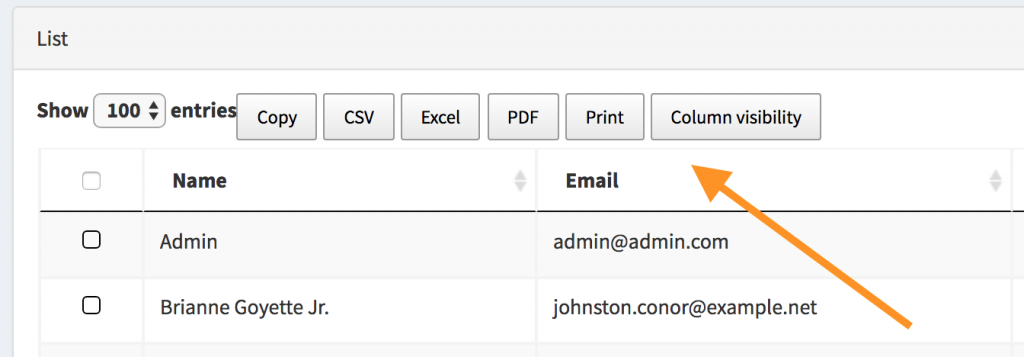
I'm talking virtually these buttons, meet above. How to manage them?
Let's go to this file: resources/views/layouts/admin.bract.php
Here we see the datatables parameters, and bolded is the array responsible for those buttons:
$.extend(true, $.fn.dataTable.defaults, { < ... > dom: 'lBfrtip<"deportment">', buttons: [ { extend: 'copy', text: window.copyButtonTrans, exportOptions: { columns: ':visible' } }, { extend: 'csv', text: window.csvButtonTrans, exportOptions: { columns: ':visible' } }, { extend: 'excel', text: window.excelButtonTrans, exportOptions: { columns: ':visible' } }, { extend: 'pdf', text: window.pdfButtonTrans, exportOptions: { columns: ':visible' } }, { extend: 'print', text: window.printButtonTrans, exportOptions: { columns: ':visible' } }, { extend: 'colvis', text: window.colvisButtonTrans, exportOptions: { columns: ':visible' } }, ] }; So, if you want to become rid of those buttons, you tin can empty that array:
$.extend(truthful, $.fn.dataTable.defaults, { < ... > buttons: [] }; The result table will look similar this:
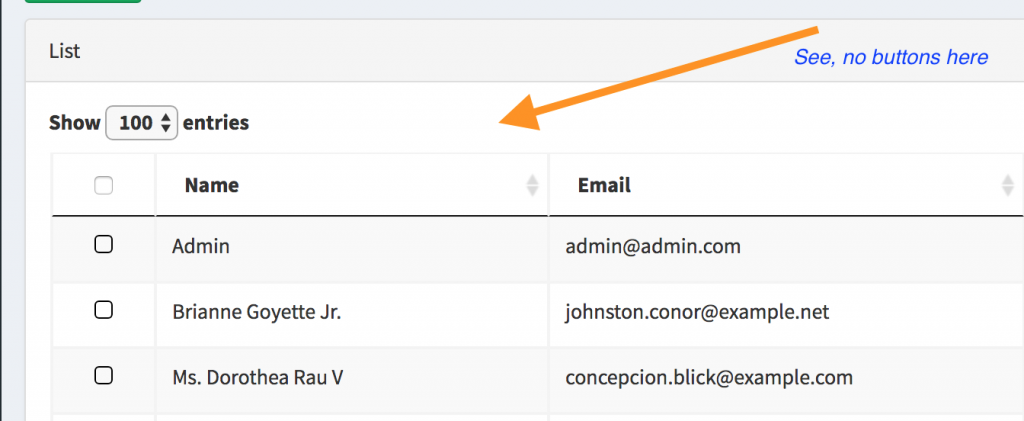
Y'all tin as well remove buttons from array one by ane, rearrange them to change the club etc.
If you lot want to change the button texts (or translate them), you should go to the same file resources/views/layouts/admin.blade.php, a little higher up:
<script> let copyButtonTrans = '{{ trans('global.datatables.copy') }}' // Translations in JavaScript let csvButtonTrans = '{{ trans('global.datatables.csv') }}' let excelButtonTrans = '{{ trans('global.datatables.excel') }}' let pdfButtonTrans = '{{ trans('global.datatables.pdf') }}' let printButtonTrans = '{{ trans('global.datatables.print') }}' permit colvisButtonTrans = '{{ trans('global.datatables.colvis') }}' </script> Every bit y'all tin can come across, you lot have the texts in translation files, so to change the actual translations – go to resource/lang/[linguistic communication]/global.php:
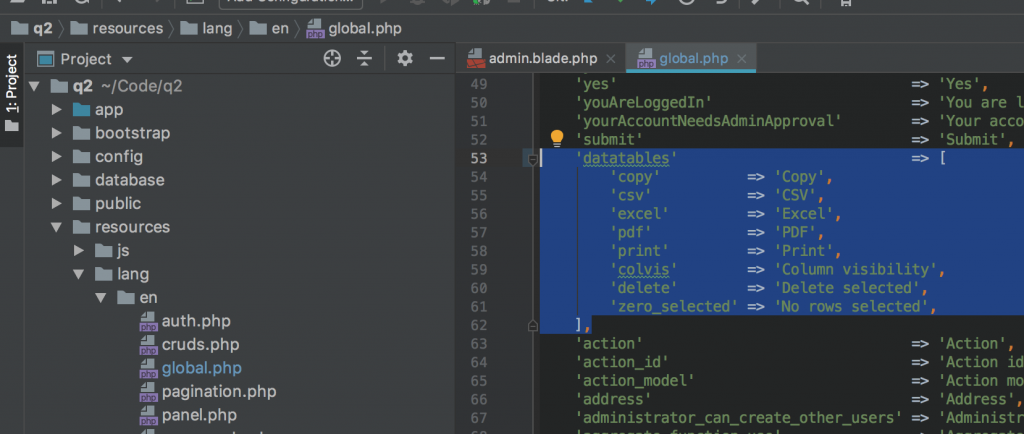
Finally, yous tin build your own custom buttons – cheque Datatables.net official documentation on this.
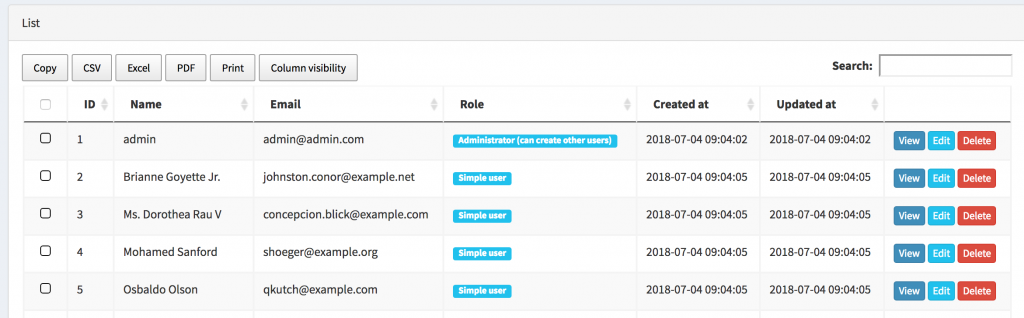
2. How to Add/Customize Table Columns: Show Timestamps
The most mutual example for our customers is asking to show more columns. By default, we hide columns similar timestamps – created_at/updated_at. So what if you lot desire to evidence them? There are a few steps:
Showing fields in resources/views/users/index.blade.php
Here's how default tabular array expect in that location:
... <th> {{ trans('cruds.user.fields.roles') }} </thursday> <th> {{ trans('cruds.user.fields.created_at') }} </thursday> <th> {{ trans('cruds.user.fields.updated_at') }} </thursday> <thursday> </th> @terminate @section('javascript') ... { data: 'email', proper noun: 'electronic mail' }, { data: 'email_verified_at', name: 'email_verified_at' }, { data: 'roles', name: 'roles.title' }, { data: 'created_at', proper noun: 'created_at' }, { information: 'updated_at', name: 'updated_at' }, Next – allow'due south add those columns to exist returned from the query.
It's in controller file'due south index() method – app/Http/Controllers/Admin/UsersController.php – line 62:
$table->editColumn('created_at', function ($row) { return $row->created_at ? $row->created_at : ""; }); $table->editColumn('updated_at', function ($row) { return $row->updated_at ? $row->updated_at : ""; }); Result:
three. How to Customize Export Columns for PDF/CSV/Excel
The virtually typical change would be to specify the columns for the consign. Luckily, all those 3 buttons above follow the same parameters.
By default, they export all visible columns from the table:
{ extend: 'csv', text: window.csvButtonTrans, exportOptions: { columns: ':visible' } }, Simply y'all can alter the columns, past specifying their numbers, what to export:
{ extend: 'csv', text: window.csvButtonTrans, exportOptions: { columns: [1, 2, 3], // Only proper name, electronic mail and office } }, Another affair you can practice is to customize the output for each cavalcade.
For example, you want to force that cavalcade to accept offset letter of the alphabet upper-case letter:
exportOptions: { columns: [one, 2, 3], format: { trunk: function ( data, row, column, node ) { return column === 0 ? information.charAt(0).toUpperCase() + data.slice(1) : information; } } }
Notice that in this example the visible columns are ane, 2 and 3, simply the uppercased column is the beginning i, with index 0. So numbering columns for formatting comes subsequently the column visibility filter.
iv. How to Customize Pagination
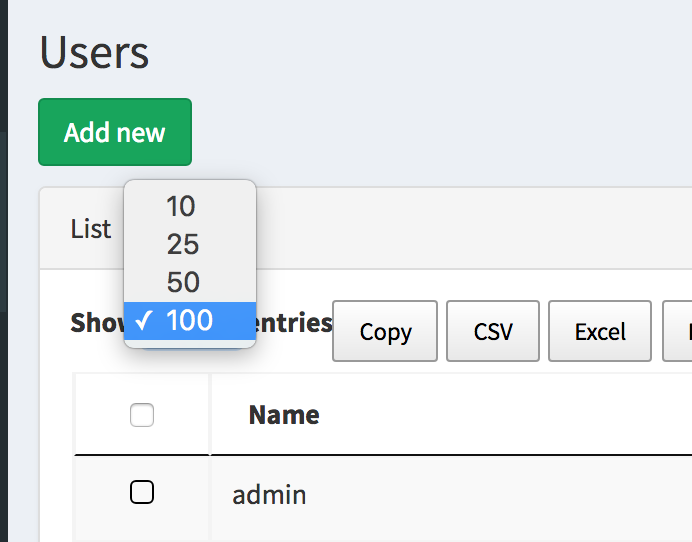
By default, Datatables "Testify X entries per folio" dropdown comes with 4 values (ten, 25, 50, 100) and default value of 100, so we override that to 25 in our generated code, and also override values for this dropdown:
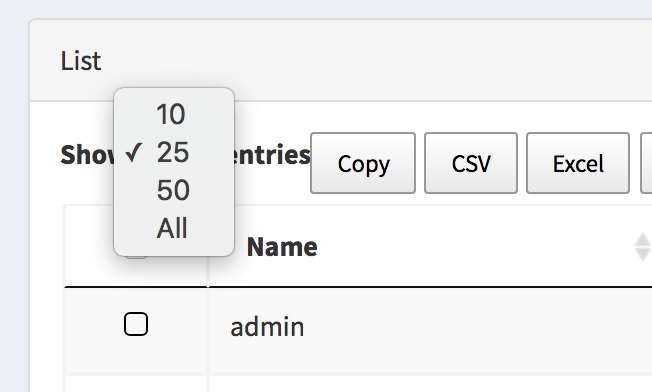
let dtOverrideGlobals = { // ... pageLength: 25, lengthMenu: [ [10, 25, l, -one], [10, 25, l, "All"] ] }; You tin besides override the values for this dropdown. Wait at this code:
It will produce this event, with 25 every bit default value, and "All" choice represented past "-1" value.
You can even disable the functionality of changing the folio length, and then leave it as 100 by default:
allow dtOverrideGlobals = { // ... "lengthChange": false, // ... 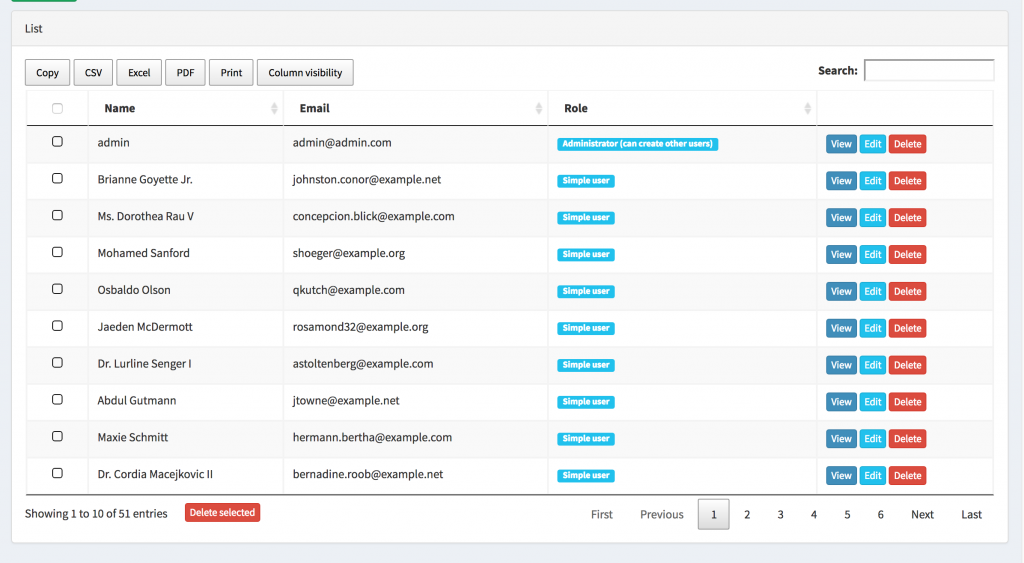
You can besides customize the buttons in the footer. Past default, they expect similar this:
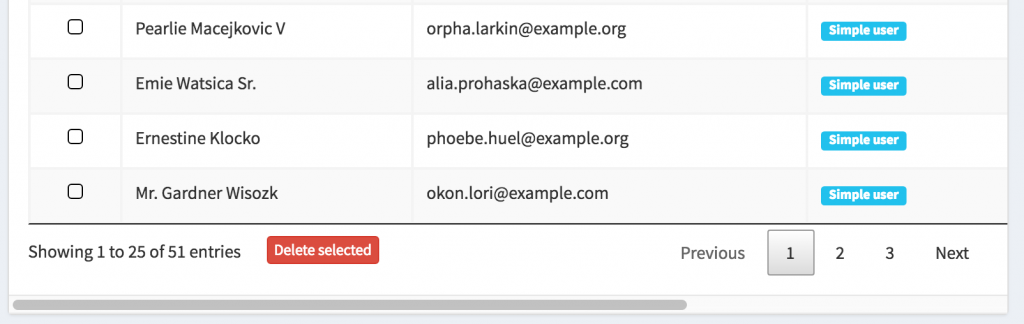
There is a belongings called pagingType:
let dtOverrideGlobals = { // ... "pagingType": "full_numbers", // ... Here are possible values:
- numbers – Page number buttons only (ane.10.eight)
- unproblematic – 'Previous' and 'Adjacent' buttons simply
- simple_numbers – 'Previous' and 'Next' buttons, plus page numbers
- full – 'Commencement', 'Previous', 'Next' and 'Last' buttons
- full_numbers – 'Kickoff', 'Previous', 'Adjacent' and 'Final' buttons, plus page numbers
- first_last_numbers – 'Commencement' and 'Last' buttons, plus page numbers
5. Change Your Language or Translate Some Text Phrases
Past default, we load Datatables.net with English language. That said, the column names, that are in Bract files, are loaded with @lang functionality, so you tin translate them in resources/lang/[language] Laravel files.
<thursday>@lang('global.users.fields.name')</th> <thursday>@lang('global.users.fields.email')</th> <th>@lang('global.users.fields.office')</thursday> But how do you translate some hard-coded Datatables words? Similar "Show X entries", "Previous/Side by side" etc.
If you want to take the whole Datatables in your own language, luckily they have a whole set up of files prepared, you simply have to load them.
Nosotros have this lawmaking in resources/views/layouts/admin.blade.php file:
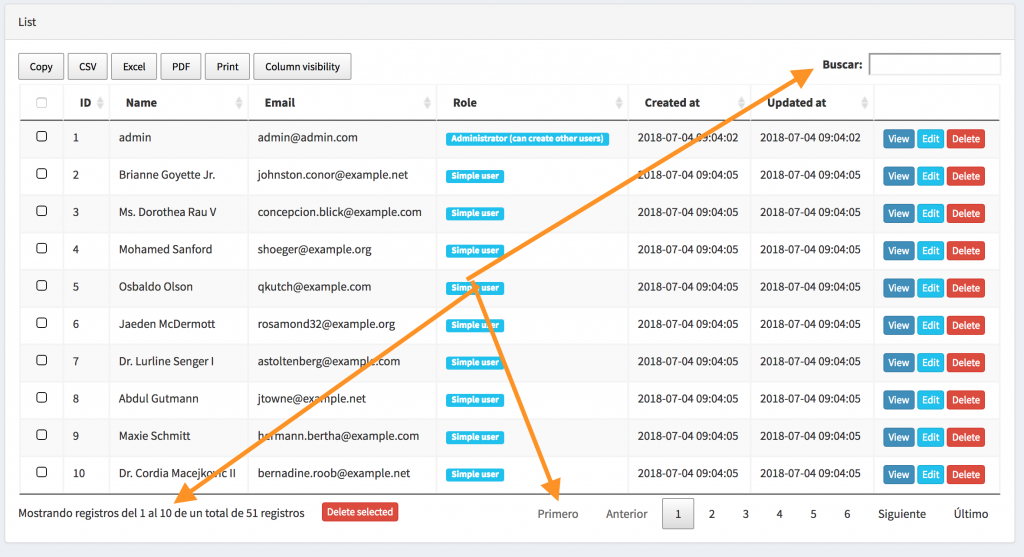
permit languages = { 'en': 'https://cdn.datatables.net/plug-ins/1.10.19/i18n/English.json', 'es': 'https://cdn.datatables.cyberspace/plug-ins/1.10.xix/i18n/Castilian.json' }; In other words, nosotros load English linguistic communication not from our system, just from Datatables CDN. Then all you need to do is to change that .json file, choose from this list.
Hither's the result:
If you want to override and translate separate texts, you can exercise that too.
Let'southward return to our config array in resources/views/layouts/admin.blade.php
$.extend(true, $.fn.dataTable.defaults, { language: { url: languages['{{ app()->getLocale() }}'] lengthMenu: "Display _MENU_ records per page", zeroRecords: "Nada found - sorry", info: "Showing page _PAGE_ of _PAGES_", infoEmpty: "No records available", infoFiltered: "(filtered from _MAX_ total records)" }, 6. How to Change Ordering past Columns
By default, Datatables listing is ordered by the start column, ascending. But yous tin hands override information technology:
allow dtOverrideGlobals = { // ... "order": [[ iii, "desc" ]] }; 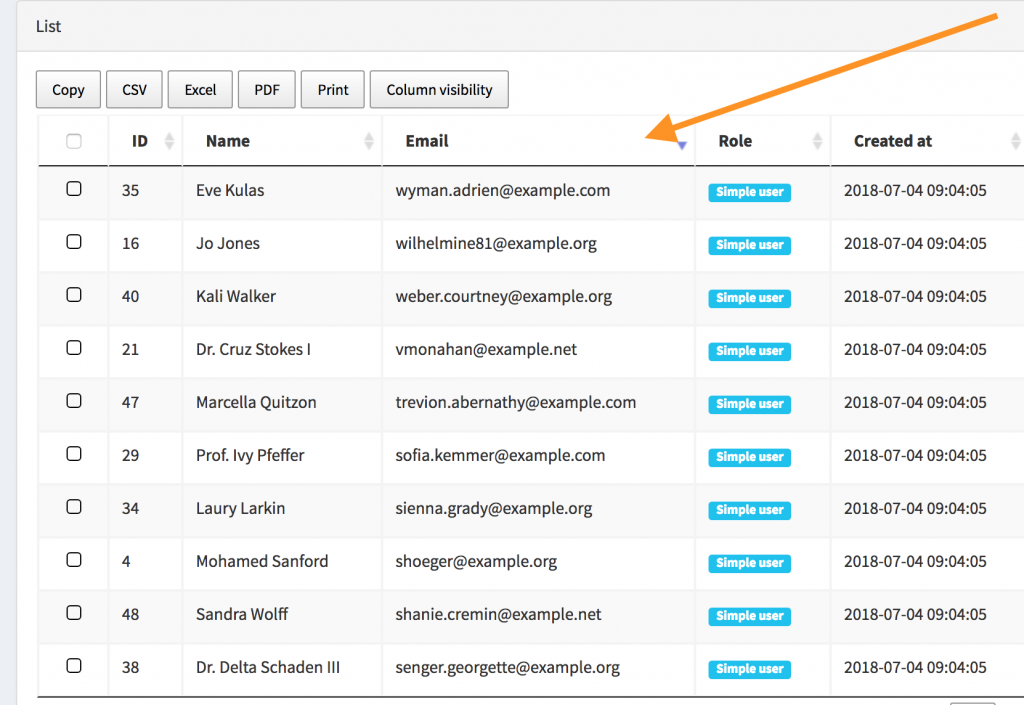
If you desire to perform multi-column ordering, information technology'south a little more than complicated.
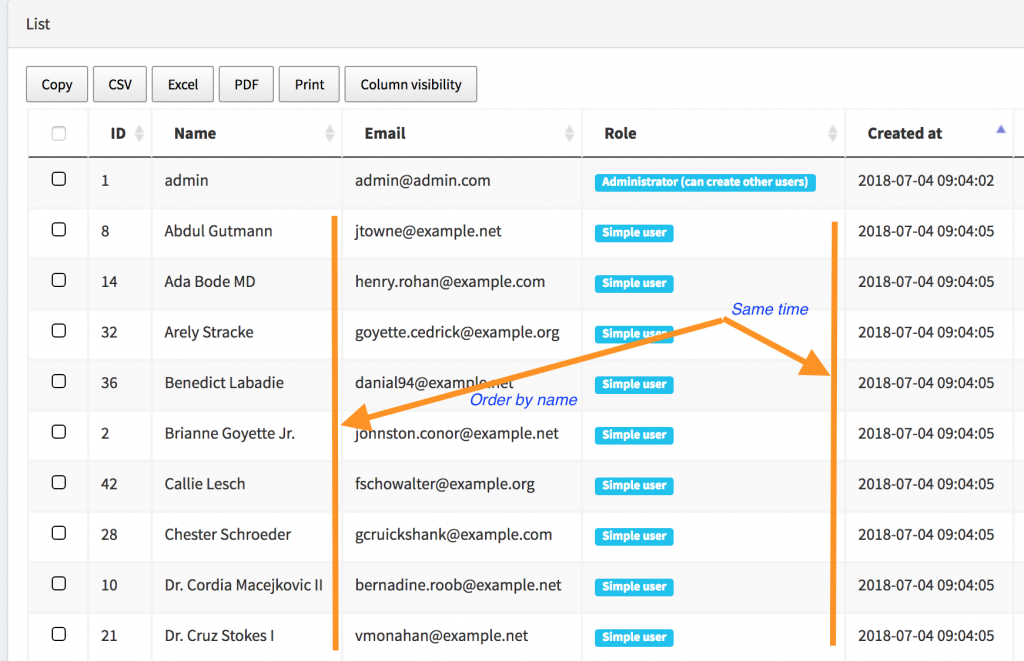
Allow'south say, you want to order by created_at asc (in other words, from oldest to newest), and and then another column would be name alphabetically.
Then the code would expect similar this:
allow dtOverrideGlobals = { "order": [[ 6, "asc" ]], columnDefs: [{ orderable: false, className: 'select-checkbox', targets: 0 }, { orderable: simulated, searchable: false, targets: -1 }, { targets: half-dozen, orderData: [ 6, 2 ] }], Here'due south the upshot visually:
These are the most mutual customizations of Datatables list, downloaded from our QuickAdminPanel. Only you can perform the same choice changes even without our generator, if you use Datatables direct in jQuery.
All those examples are published in a demo Github repository.
For more data, visit official Datatables.internet documentation and Laravel Datatables parcel documentation.
Source: https://blog.quickadminpanel.com/how-to-customize-datatables-6-most-requested-tips/
0 Response to "Datatables Stop Current Post and Start Again on Request"
Post a Comment